Since light travels at a very high speed, early attempts to measure its speed were unsuccessful. For example, Galileo tried by using to observers separated by about 10km, but their reaction time was greater than the transit time of light.
In 1675, Ole Roemer used astronomical observations to estimate the speed of light, instead: using the period of revolution of Io, as Jupiter revolved around the Sun. The angle through which Jupiter moves during a movement of the Earth was calculated. Using this data, Huygens estimated the lower limit of the speed of light to be ms. Note that due to limitations with clocks, this method differed in the past (more rotations, for example).
In 1849, Armand Fizeau successfully measured the speed of light without astronomy, simply by using a toothed wheel and a mirror. This could’ve happened centuries ago, but only in the mid 19th century was the engineering precise enough to develop the toothed wheels.
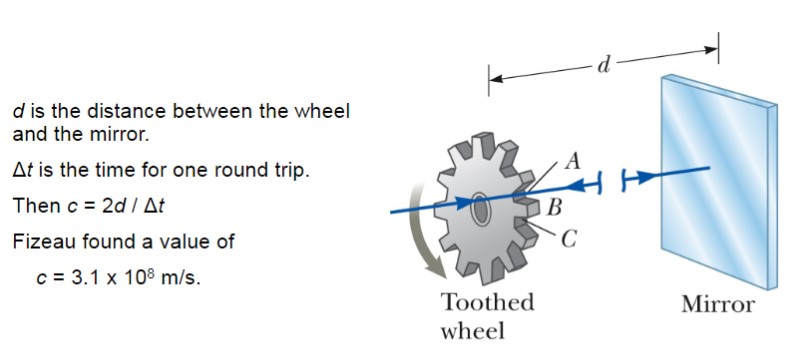 Fizeau technique