31OCT=25DEC⟹ because 31 in base 8 is equal to 25 in base 10 (8⋅3+1)
Question 1 §
(2x+1)(3x2+2)(4x3+3)(5x4+4)(6x5+5)
⟹(2x⋅3x2⋅4x3⋅5x4⋅6x5)+⋯+(1⋅2⋅3⋅4⋅5)
⟹720x15+⋯+120
∴The degree is 15 and the constant term is 120.
Question 2 §
2x5+x3−5x2+2=(2x2−1)q(x)+r(x)
Answers to Algebra Practical 4 2023-10-20 08.59.09.excalidraw
So, by polynomial long division,
q(x)=x3+x−25,r(x)=x−21
LHS=RHS∴valid solution
Question 3 §
(3x2+x−1)(2x3−2x2−x+2)−(x3+2x2−4x−11)(6x2−x+9)
⟹(6x5−6x4+2x4+⋯)−(6x5−x4+12x4+⋯)
⟹(−4x4+⋯)−(11x4+⋯)
⟹−15x4+⋯
∴Degree is 4 and the leading coefficient is -15.
Question 4 §
4x4−8x3+6x2+21x−215=(x−23)q(x)+r(x)
⟹8x4−16x3+12x2+x−15=2[(x−23)q(x)+r(x)]
| (1.5) | 8 | -16 | 12 | 1 | -15 |
|---|
| 0 | 0 | 12 | -6 | 9 | 15 |
| 8 | -4 | 6 | 10 | 0 |
∴2q(x)=8x3−4x2+6x+10,2r(x)=0
⟹q(x)=4x3−2x2+3x+5,r(x)=0
∴their quotient is 4x3−2x2+3x+5, which is a mutiple of the quartic.
Question 5 §
x2+3x+4(x+3)(x2−x−1)=f(x)+h(x)g(x)
⟹(x+3)(x+1)(x+3)(x2−x−1)=x+1x2−x−1=f(x)+h(x)g(x)
Answers to Algebra Practical 4 2023-10-20 10.21.25.excalidraw
Thus, f(x)=x−2,g(x)=1:
x2+3x+4(x+3)(x2−x−1)=f(x)+h(x)g(x):f(x)=x−2,g(x)=1,h(x)=x+1
∴x−2+x+11
Checking my answer §
x−2+x+11⟹x+1(x−2)(x+1)+1⟹x+1x2−x−1
⟹x+1x2−x−1⋅x+3x+3⟹x2+4x+3(x+3)(x2−x−1)
Answer is incorrect - the initial denominator was factorised incorrectly.
Correct answer §
x2+3x+4(x+3)(x2−x−1)=f(x)+h(x)g(x)
⟹x2+3x+4(x+3)(x2−x−1)=h(x)f(x)h(x)+g(x)∴h(x)=x2+3x+4
⟹x3+2x2−4x−3=(x2+3x+4)f(x)+g(x)
Answers to Algebra Practical 4 2023-10-20 10.39.44.excalidraw
∴f(x)=x−1,g(x)=−5x+1,h(x)=x2+3x+4
Question 6 §
x3−2x2−30x−40=⋯+c2(x+3)+c1(x+3)+c0
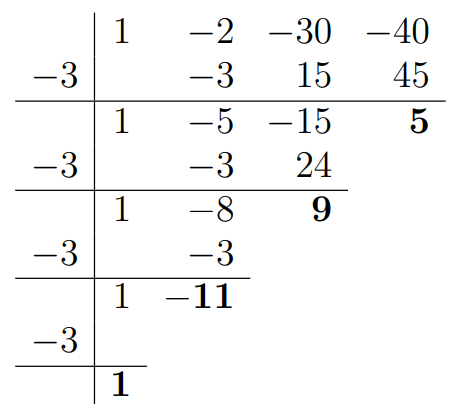
∴c0=5,c1=9,c2=−11,c3=1
Question 7 §
Factorise the following expressions as far as you can over R, that is, using only real numbers:
Question A §
a2+b2−c2−2ab
⟹(a+b)2−c2
⟹(a−b−c)(a−b+c) by difference of two squares
Question B §
8x3+b6
⟹(b2+2x)(b4−2b2x+4x2) by inspcetion
Question C §
x8−a8
⟹(x4+a4)(x4−a4) by difference of two squares
⟹(x4+a4)(x2+a2)(x2−a2) by difference of two squares
⟹(x4+a4)(x2+a2)(x+a)(x−a) by difference of two squares
Question 8 §
(i)x4+(−1+i)x3+(−4−i)x2+(−2−3i)x+(−6+3i)=[x−(−2+i)]q(x)+r(x)
| (-2+i) | i | -1+i | -4-i | -2-3i | -6+3i |
|---|
| 0 | -1-2i | 5 | -1+3i | 6-3i |
| i | -2-i | 1-i | -3 | 0 |
⟹q(x)=ix3−(2+i)x2+(1−i)x−3,r(x)=0∴factor