Mirrors and Lenses
Mirrors and lenses (useful equations etc.)
Introduction
Mirrors and lenses have played a vital role in shaping our understanding of light and optics. From the ancient Egyptians using polished metal mirrors to the telescopes and cameras of the modern era, the principles governing their operation remain consistent.
Images Formed by Flat Mirrors
Image Formation
- An image formed by a flat mirror is always virtual, upright, and the same size as the object.
- The distance of the object from the mirror equals the distance of the image from the mirror.
Notation for Mirrors and Lenses
- Object distance ()
- Image distance ()
- Focal length ()
Images
- Real Image: Formed when light rays converge.
- Virtual Image: Formed when light rays seem to diverge from a point.
Geometry and Algebra
- Geometry: The angle of incidence equals the angle of reflection.
- Algebra: for flat mirrors.
Reversals in a Flat Mirror
- Left-right reversal: Objects appear reversed in a flat mirror.
Applications
- Day and night settings on auto mirrors: Designed to reduce the glare from headlights during nighttime driving.
Spherical Mirrors
Concave Mirror Notation
- Center of curvature ()
- Focal point ()
- Principal axis
Paraxial Rays
- Rays close to and almost parallel to the principal axis.
Focal Length and Focal Point
- where is the radius of curvature.
- Focal point: Point where parallel rays either converge (for concave mirrors) or seem to diverge (for convex mirrors).
Image Formed by a Concave Mirror
- Can be real or virtual, depending on the object’s position in relation to the focal point.
Spherical Aberration
- Distortion caused by rays far from the principal axis not converging at the focal point.
Convex Mirrors
- Consistently form a virtual, upright, and diminished image.
Image Formed by a Convex Mirror
Sign Conventions
- Object distance is considered positive if the object is on the same side as the incoming light.
- Image distance is positive if the image is on the same side as the outgoing light.
Sign Conventions Summary Table
| Quantity | Positive Value | Negative Value |
|---|---|---|
| Object Distance | Real Object | Virtual Object |
| Image Distance | Real Image | Virtual Image |
| Focal Length | Converging | Diverging |
Ray Diagrams
- A graphical method used to determine the location, size, and orientation of images.
Rays in Ray Diagrams for Concave and Convex Mirrors
- Parallel ray: Passes through or appears to diverge from the focal point.
- Focal ray: Becomes parallel to the principal axis after reflection.
- Central ray: Reflects back along its initial path.
Images Formed by Refraction
- Occur due to the bending of light at an interface between two different media.
Sign Conventions for Refracting Surfaces
| Quantity | Positive Value | Negative Value |
|---|---|---|
| Object Distance | Real Object | Virtual Object |
| Image Distance | Real Image | Virtual Image |
Thin Lens Shapes
- Converging (Convex): Gathers parallel rays.
- Diverging (Concave): Causes parallel rays to spread out.
Images Formed by Lenses
- Converging lenses can produce real or virtual images.
- Diverging lenses only create virtual images.
Lens-makers’ Equation
Image Formed by a Thin Lens
Determining Signs for Thin Lenses
- Use the same conventions as with mirrors.
Magnification of Images Through a Thin Lens
Ray Diagrams for Converging/Diverging Thin Lenses
- They operate on principles similar to mirrors, but they consider refraction.
Image Summary
- Real images are inverted and located on the opposite side.
- Virtual images are upright and appear on the same side.
Combinations of Thin Lenses
- For lenses in contact:
Lens Aberrations
- Spherical Aberration: Caused by the spherical shape of lenses.
- Chromatic Aberration: Arises from the dispersion of light.
Fresnel Lens
- A lightweight lens featuring a series of concentric rings, which reduces both weight and required material.
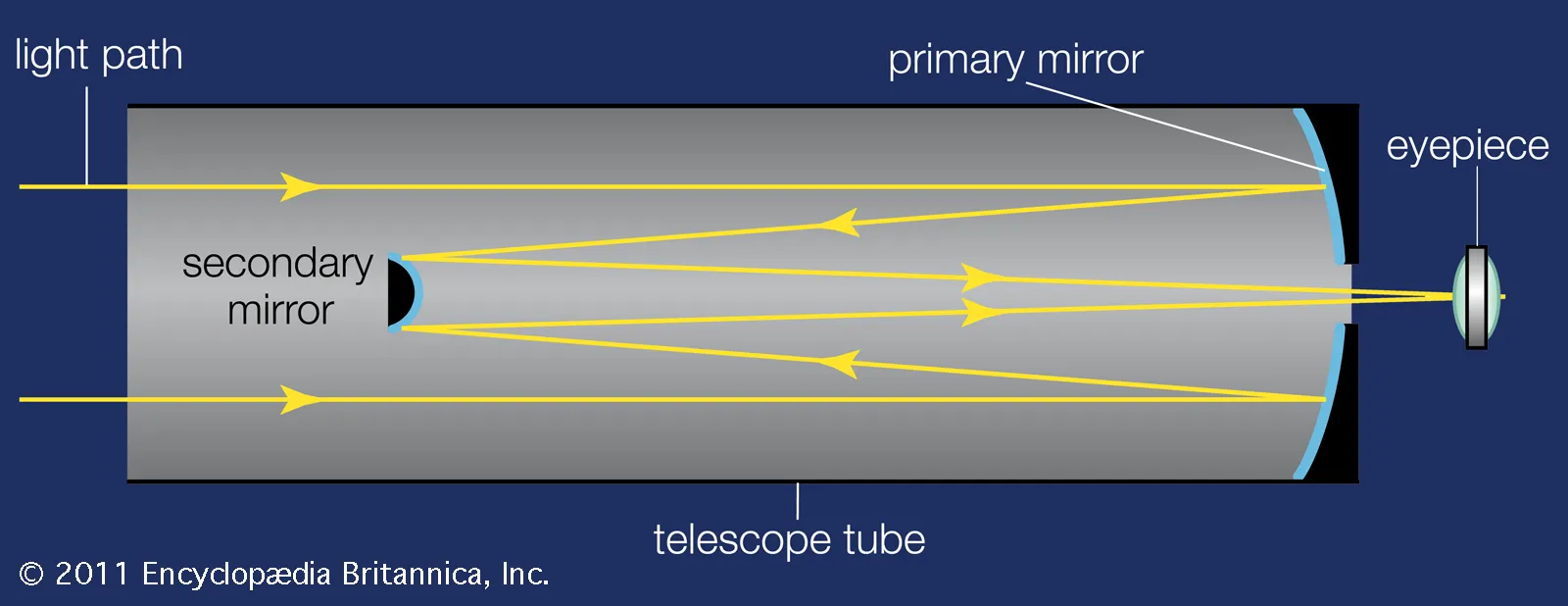
Reflecting Telescope (Newtonian Focus)
- Uses a concave mirror to collect light and produce an image; works due to the geometric nature of a parabola.
Historical Background
Ancient Civilizations
- Ancient Egyptians: Employed polished metals, such as copper, to create mirrors.
- Ancient Greeks: They had a basic understanding of the principles of reflection and refraction. The renowned mathematician Euclid discussed the laws of reflection in his “Optica” around 300 BCE.
Middle Ages
- Alhazen (Ibn al-Haytham): This Arab scientist authored the “Book of Optics” in the 11th century. Often dubbed the “father of modern optics”, he made significant strides in the realms of vision, reflection, and refraction.
Renaissance
- Concave and Convex Mirrors: Used artistically to achieve unique perspectives, most notably in Jan van Eyck’s “Arnolfini Portrait” and in sketches by Leonardo da Vinci.
- Telescopes: In the early 17th century, figures such as Galileo Galilei pioneered the invention of the telescope, which radically transformed the field of astronomy. This device harnessed the principles of lenses to magnify distant entities.
18th and 19th Centuries
- Development of Lenses: The birth of photography in the 19th century spurred the need to craft higher-quality lenses to enhance image clarity.
- Fresnel Lens: Conceived by the French engineer Augustin-Jean Fresnel for lighthouse applications.
20th Century to Present
- Optical Instruments: The era witnessed the advent of tools like microscopes, cameras, and a plethora of telescopes, all of which are reliant on the mechanisms of lenses and mirrors.
- Laser Technology: The principles of reflection and refraction are integral to the conception and operation of lasers.
Test Questions
- What type of image does a flat mirror produce?
- Define the terms ‘real image’ and ‘virtual image’.
- How is the focal length of a spherical mirror related to its radius of curvature?
- Describe the image formed by a convex lens when the object is placed beyond its focal point.
- Who is regarded as the “father of modern optics” and why?
Conclusion
Mirrors and lenses have not only been instrumental in our grasp of optics but have also shaped the trajectory of human history. Their application in various fields, from art to astronomy and beyond, underscores their paramount importance.